
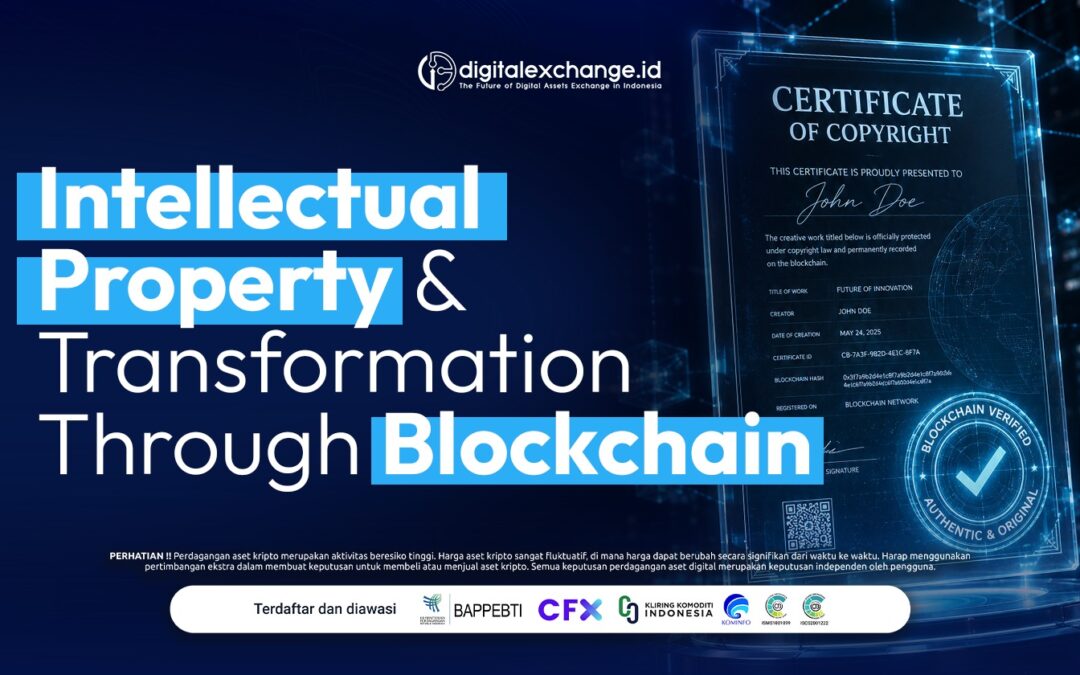
Intellectual Property has long been associated with complex copyright, patent, and royalty management processes involving numerous intermediaries. Through blockchain, these processes are beginning to become more transparent, efficient, and easily verifiable, creating new opportunities for creators in the digital era.
The development of the digital economy has made intellectual works such as music, art, design, and patents increasingly valuable. However, the management of rights to these works still faces various challenges, ranging from complex registration processes to royalty distribution that is often less transparent. In many cases, creators must also rely on various intermediaries that can slow down payment processes and reduce the share of income they receive.
Amid these changes, blockchain is beginning to offer a new approach to the management of intellectual assets. With its ability to record data transparently and immutably, this technology creates opportunities to establish a more efficient system for copyright protection, ownership, and royalty distribution.
What Is Intellectual Property?
Intellectual Property (IP) encompasses various forms of human creativity, such as works of art, music, literature, designs, trademarks, as well as inventions and patents. Traditionally, IP management relies on specific institutions or authorities responsible for recording, protecting, and regulating rights to a work.
Although this system has been used for many years, the process is often considered slow, expensive, and lacking in transparency, particularly in terms of royalty distribution. In addition, proving ownership and tracking the use of a work can become challenging when multiple parties and different legal jurisdictions are involved.
In this context, blockchain introduces a new approach through a decentralized, transparent, and immutable digital record-keeping system. Every transaction or piece of data recorded on the blockchain can be verified and is not easily manipulated, providing an additional layer of trust in the management of intellectual assets.
One of the primary applications of blockchain in Intellectual Property is proof-of-existence, namely the ability to record proof of ownership or the creation time of a work through a digital timestamp. In addition, blockchain also enables the tokenization of intellectual assets in the form of NFTs or other digital tokens that can directly represent ownership.
Furthermore, smart contract technology enables royalty distribution to be carried out automatically according to predetermined rules. With this approach, Intellectual Property no longer functions solely as a legal asset but can also become a digital asset that is easier to manage, trade, and monetize in the blockchain era.
Mechanism of Intellectual Property in Blockchain
One of blockchain’s advantages in Intellectual Property is its ability to connect ownership records, license management, and royalty distribution within a single transparent system. By utilizing smart contracts, various processes that were previously performed manually can operate automatically and more efficiently.
In general, the mechanism of Intellectual Property Management & Royalty Distribution through blockchain can be explained through the following stages:
-
- Work Registration
Creators upload metadata or a hash of their work to the blockchain. This process creates proof of ownership and creation time that can be verified at any time.
- Work Registration
-
- Asset Tokenization
The work can then be represented in the form of an NFT or another digital token. Asset ownership is recorded transparently on the blockchain and can be transferred as needed.
- Asset Tokenization
-
- License Management Through Smart Contracts
Terms of use, such as license duration, usage territory, or royalty rates, are encoded into smart contracts so they can be executed automatically.
- License Management Through Smart Contracts
-
- Automatic Royalty Distribution
When the work is used or generates revenue, smart contracts distribute payments directly to the entitled parties according to predetermined percentages.
- Automatic Royalty Distribution
-
- Tracking and Verification
The entire history of ownership, transactions, and usage of the work can be traced transparently, helping reduce the risk of counterfeiting and ownership disputes.
- Tracking and Verification
With this mechanism, creators no longer have to depend entirely on lengthy administrative processes to receive royalties. Payments can be made more quickly and transparently, while all parties involved have access to the same information.
In practice, this system also enables fractional ownership through tokenization, allowing a single intellectual asset to be owned by multiple parties simultaneously. This approach creates new opportunities for monetizing works and establishes a more flexible creative economy model.
Benefits of Applying Blockchain to Intellectual Property
The use of blockchain in Intellectual Property not only introduces a new way to record ownership of works but also improves efficiency in managing and distributing the economic value they generate. By reducing dependence on intermediaries, this technology creates opportunities for creators to have greater control over their intellectual assets.
Some of the main benefits of blockchain in Intellectual Property Management & Royalty Distribution include:
-
- Greater transparency and trust
The entire history of ownership, licensing, and royalty distribution can be verified openly without relying on a single party.
- Greater transparency and trust
-
- Administrative process efficiency
Work registration, license management, and royalty distribution can be carried out more quickly compared to traditional systems involving many manual steps.
- Administrative process efficiency
-
- Fairer royalty distribution
Smart contracts enable payments to be made automatically and in real time according to previously agreed rules.
- Fairer royalty distribution
-
- Reduced intermediary involvement
Creators have the potential to receive a larger share of revenue due to reduced dependence on intermediaries in the distribution process.
- Reduced intermediary involvement
-
- More flexible monetization
Tokenization enables intellectual assets to be traded, fractionally owned, or utilized in new business models that were previously difficult to implement.
- More flexible monetization
-
- Protection against counterfeiting and ownership disputes
Proof of ownership permanently recorded on the blockchain helps strengthen verification processes and the tracking of work usage.
- Protection against counterfeiting and ownership disputes
In addition to benefiting individual creators, this approach also has the potential to improve efficiency for companies, license holders, and institutions managing intellectual assets on a large scale. With access to more transparent data, auditing and rights management processes become easier to perform.
In the long term, blockchain can transform intellectual property from an asset that is relatively difficult to trade into a digital asset that is more liquid and easier to monetize. This is what makes the technology increasingly attractive to the creative industries, entertainment, and the innovation and patent sectors.
Challenges of Applying Blockchain to Intellectual Property
Although it offers greater transparency and efficiency, the implementation of blockchain in Intellectual Property still faces several challenges that need to be resolved before it can be widely adopted. Regulatory factors, technology, and ecosystem readiness are important aspects that influence the development of this solution.
Some of the main challenges in implementing blockchain for Intellectual Property Management & Royalty Distribution include:
-
- Legal and regulatory aspects
Recognition of smart contracts and digital assets still differs from one country to another, which can create legal uncertainty in IP management.
- Legal and regulatory aspects
-
- Adoption and interoperability
Integration with existing copyright management systems and databases requires more uniform standards at the global level.
- Adoption and interoperability
-
- Technical limitations
Transaction costs, network scalability, and dependence on oracles for external data remain challenges in large-scale implementation.
- Technical limitations
-
- Enforcement of rights in the real world
Blockchain can serve as strong proof of ownership, but dispute resolution and legal enforcement still require the role of institutions and courts.
- Enforcement of rights in the real world
-
- Volatility and accessibility
Cryptocurrency asset fluctuations and the learning curve associated with blockchain technology can become obstacles for creators who are not yet familiar with the digital ecosystem.
- Volatility and accessibility
In addition, there are challenges in building trust and understanding among participants in the creative industry. Many creators and organizations still use conventional systems that have been in place for years, so the transition process toward blockchain-based models requires time, education, and adequate infrastructure support.
Nevertheless, the development of industry standards, improvements in blockchain scalability, and the growing number of real-world implementation examples show that these obstacles are gradually being addressed. This creates opportunities for Intellectual Property to evolve into a more transparent, efficient, and inclusive system in the future.
Real-World Examples of Blockchain Applications in Intellectual Property
The implementation of blockchain in Intellectual Property has begun to be applied across various sectors, ranging from patent management and copyright protection to music royalty distribution. This development demonstrates that blockchain technology is no longer used only for crypto assets, but is also becoming a supporting infrastructure within the creative economy and innovation sectors.
Some examples of Intellectual Property Management & Royalty Distribution applications in the real world include:
EUIPO (European Union Intellectual Property Office)
EUIPO has developed the IP Register in Blockchain initiative as part of its strategy to digitalize intellectual property management in Europe. This system enables the exchange of IP data among member countries in a more secure, faster, and transparent manner, while also supporting product authentication processes to reduce counterfeiting.
IPwe and IBM
The collaboration between IPwe and IBM has introduced a blockchain-based patent marketplace that allows patent assets to be represented as NFTs. This approach creates new opportunities for patent trading, licensing, and monetization, an asset class traditionally known for its low liquidity.
Music Industry
The music sector is one of the most active areas adopting blockchain for royalty distribution. Platforms such as Royal, supported by musician 3LAU, allow artists to sell portions of song royalty rights as tokens to fans and investors.
In addition, platforms such as Ujo Music, Audioshare, and BitSong utilize smart contracts to distribute royalties automatically and more transparently. Standards such as EIP-2981 on Ethereum also help ensure royalty payments from NFT sales in secondary markets.
Digital Art and Creators
Blockchain is also used to record certificates of authenticity for artworks and create verifiable ownership histories. Platforms such as Verisart and Blockai utilize blockchain timestamping to help artists and creators prove ownership of their works.
Other Sectors
Beyond the creative industries, this technology is also being tested in sectors such as semiconductors, architectural design, and corporate intellectual asset management. These experiments demonstrate that blockchain has the potential to be applied to nearly all forms of intellectual assets that require transparency and ownership tracking.
With an increasing number of real-world implementations, blockchain is beginning to demonstrate its ability to improve the efficiency of Intellectual Property management while opening new monetization models that were previously difficult to achieve through traditional systems.
Future Impact on the Economy
The development of blockchain in Intellectual Property has the potential to bring major changes to the way intellectual assets are created, managed, and monetized. Traditionally, many assets such as copyrights, patents, and designs, possess high economic value but are relatively difficult to trade and often depend on lengthy administrative processes. Blockchain offers a more open and efficient approach to addressing these challenges.
From an economic perspective, the impact of blockchain on Intellectual Property can be seen through several key aspects:
-
- Democratization of the creative economy
Independent creators can reach global markets without having to rely entirely on labels, publishers, or traditional intermediaries.
- Democratization of the creative economy
-
- Increased liquidity of intellectual assets
Tokenization enables copyrights, patents, and other intellectual assets to be traded more easily, unlocking economic value that was previously difficult to access.
- Increased liquidity of intellectual assets
-
- New monetization models
Fractional ownership and automated royalties create more flexible income opportunities for both creators and investors.
- New monetization models
-
- Encouraging innovation and collaboration
In research and science, concepts such as IP-NFTs have the potential to support research funding through more open and transparent mechanisms.
- Encouraging innovation and collaboration
-
- Reduction of losses from piracy and counterfeiting
Verifiable record-keeping systems help strengthen the protection of intellectual works and improve ownership verification processes.
- Reduction of losses from piracy and counterfeiting
In addition, integrating blockchain with other technologies, such as AI, has the potential to accelerate copyright infringement detection and automate intellectual asset management. At the same time, the emergence of global standards and hybrid models combining on-chain systems with traditional legal frameworks may help expand adoption across various industries.
In the context of Indonesia, this technology also creates opportunities to strengthen the growing digital creative economy. With increasing numbers of creators, creative MSMEs, and innovators, a more transparent and efficient Intellectual Property system can help create an environment that better supports innovation-driven economic growth.
With the current direction of development, blockchain has the potential to transform Intellectual Property from merely a legal protection instrument into an economic asset that is more liquid, accessible, and integrated into the global digital economy.
Conclusion
The development of blockchain in Intellectual Property shows that the management of copyrights, patents, trademarks, and other intellectual assets is entering a more transparent and automated era. Through features such as timestamping, tokenization, and smart contracts, this technology helps simplify processes that have long been considered complex while increasing trust among the parties involved.
On one hand, blockchain creates new opportunities for creators, innovators, and intellectual asset owners to monetize their works more efficiently. Faster royalty distribution, verifiable ownership, and access to global markets are among the benefits that are attracting increasing attention across industries.
On the other hand, challenges such as regulation, system interoperability, and technology adoption still need to be addressed before implementation can expand more broadly. However, the growing number of real-world projects in music, art, patents, and the creative economy demonstrates that this transformation continues to move forward.
With the development of asset tokenization, smart contracts, and increasingly mature global standards, blockchain has the potential to transform Intellectual Property from a system dependent on numerous intermediaries into a more open, efficient, and inclusive ecosystem. The question is no longer whether this transformation will occur, but how quickly the creative and innovation industries are ready to adapt to this new model.
Mulailah Transaksi Kripto yang Bijak dan Mudah Sekarang!
Untuk platform dalam bertransaksi kripto termasuk trading aset kripto, kamu dapat memilih digitalexchange.id.
digitalexchange.id adalah salah satu platform terkemuka dan terpercaya yang menyediakan layanan transaksi crypto yang aman, cepat, dan handal. Kami menawarkan berbagai fitur yang membantu kamu dalam melakukan analisis pasar, mengelola portofolio, dan menjalankan transaksi dengan mudah. Selain itu, digitalexchange.id juga memiliki reputasi yang baik di industri crypto dan menyediakan dukungan pelanggan yang responsif.
Dengan memanfaatkan platform digitalexchange.id, kamu dapat meningkatkan peluangmu untuk meraih keuntungan dalam trading crypto. Yuk daftar dan transaksi kripto sekarang juga!
Butuh platform jual beli crypto Indonesia dengan spread harga rendah dan liquidity yang cepat?
digitalexchange.id akan menjawab kebutuhanmu


Tersedia di App Store &Play Store