 Insight & Edukasi
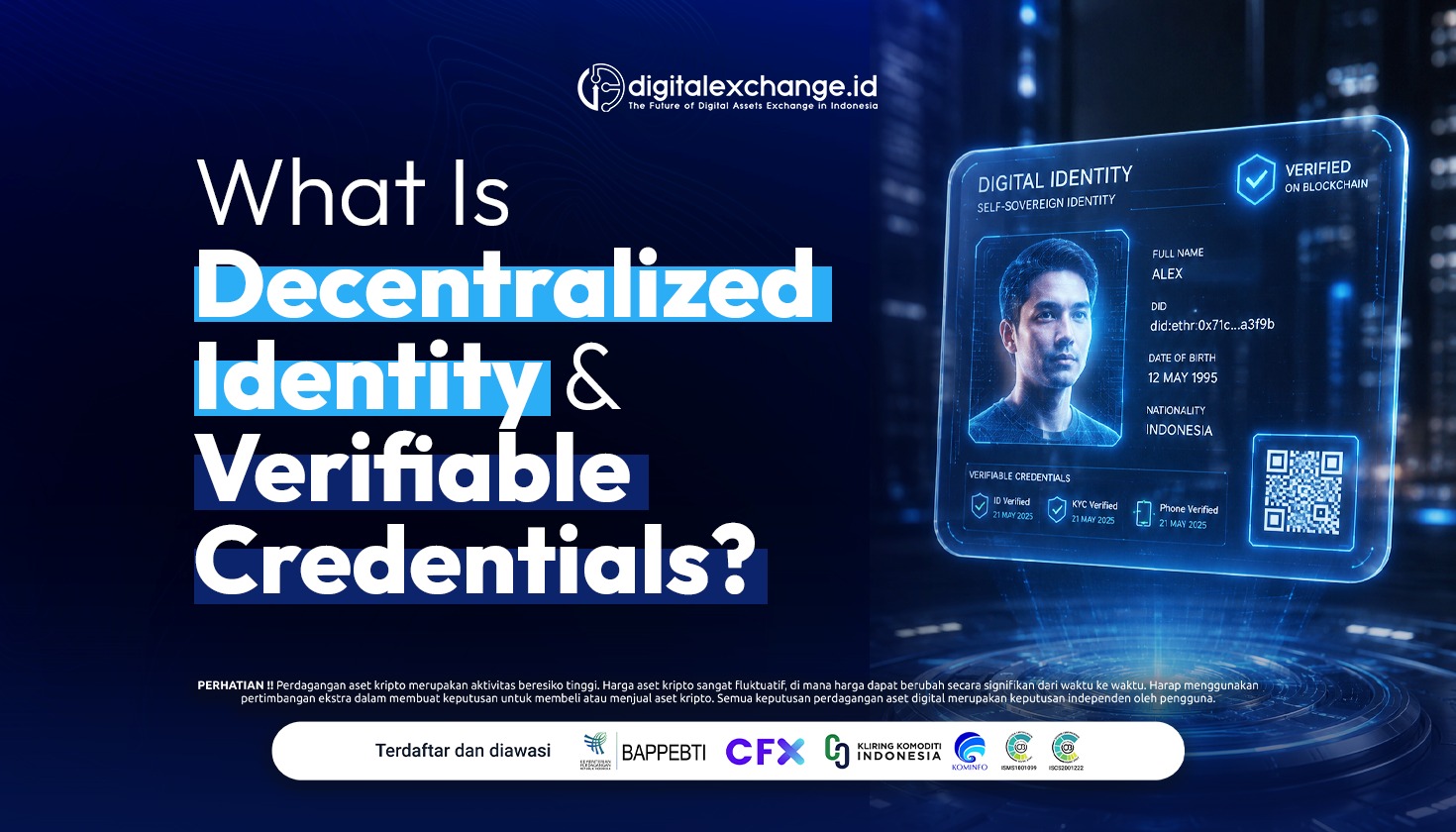
Decentralized Identity & Verifiable Credentials offer a new way to manage digital identities without relying on centralized databases. Amid the growing need for privacy and online verification, this approach is becoming a new foundation in the Web3 era.
The development of the internet and digital services has made identity an important part of almost all online activities. However, current identity systems still have various limitations, ranging from dependence on third parties to the high risk of data breaches. In many cases, users also have to repeatedly go through identity verification processes across different platforms.
Amid the increasing need for privacy and data security, a new approach has emerged that gives users direct control over their identities. In this context, Decentralized Identity & Verifiable Credentials are beginning to develop as a new foundation for digital identity systems in the Web3 era.
Definition of Decentralized Identity & Verifiable Credentials
Decentralized Identity & Verifiable Credentials are blockchain-based digital identity systems that allow users to manage and prove their identities without relying on centralized databases. This approach is often referred to as Self-Sovereign Identity (SSI) because the primary control lies in the hands of users, not platforms or specific institutions.
In this system, Decentralized Identifiers (DIDs) function as unique identities directly controlled by users. DIDs do not store personal data directly but are connected to DID Documents containing authentication information such as public keys.
Meanwhile, Verifiable Credentials (VCs) are digital representations of real documents or credentials, such as KYC, diplomas, certificates, or other forms of identity. VCs are cryptographically signed by issuers so they can be verified without having to contact the document issuer every time they are used.
This model generally involves three main parties:
-
- Issuer, the party issuing credentials, such as universities, banks, or governments
- Holder, the user who stores credentials in a digital wallet
- Verifier, the party verifying credentials without needing access to the user’s raw data
To support privacy, this system is also beginning to adopt technologies such as Zero-Knowledge Proofs (ZKP), allowing users to prove specific information without revealing all their data.
With the combination of DID, VC, and privacy technologies, Decentralized Identity & Verifiable Credentials provide a digital identity approach that is more secure, interoperable, and efficient compared to traditional systems.
Mechanism of Decentralized Identity & Verifiable Credentials
The Decentralized Identity & Verifiable Credentials approach is designed so that identity verification processes can be carried out without continuously depending on centralized databases. This system allows users to maintain direct control over their data while still being able to securely prove identity validity.
In general, the system works through the following stages:
- Credential issuance
Issuers such as banks, universities, or platforms verify the user’s identity, then issue Verifiable Credentials (VCs) cryptographically signed using their DID. - Storage in a wallet
Users store these credentials in digital wallets that support DID and VC. - Credential presentation
When needed, users can share credentials or parts of their information with verifiers. - Verification process
Verifiers check the validity of digital signatures, credential status, and issuer authenticity without needing to directly contact the issuer.
With this mechanism, users do not need to repeat identity verification processes across multiple platforms. For example, after completing KYC on one service, users can use the same credential for onboarding on another platform without re-uploading documents.
In addition to improving efficiency, this approach also strengthens user privacy. Through technologies such as Zero-Knowledge Proofs (ZKP), users can prove certain information—such as age or KYC status—without revealing all their personal data.
In practice, Decentralized Identity & Verifiable Credentials not only change how identities are verified but also reduce dependence on centralized data storage, vulnerable to leaks and misuse.
Siap mempraktikkan strategi ini?
Beli & jual 90+ aset kripto di exchange berizin dan diawasi OJK, mulai dari Rp10.000.
Global Adoption of Decentralized Identity & Verifiable Credentials
The implementation of Decentralized Identity & Verifiable Credentials is growing across various sectors, from government and education to the crypto and Web3 ecosystem. This development shows that decentralized identity technology is no longer merely conceptual but is already being used in real activities.
Some examples include:
-
- EU eIDAS 2.0 & EUDI Wallet
The European Union is developing the European Digital Identity Wallet, enabling citizens to use cross-border digital identities based on DID and VC approaches.
- EU eIDAS 2.0 & EUDI Wallet
-
- Education and certification
Universities are beginning to issue diplomas and certificates as Verifiable Credentials, allowing instant verification without manual processes.
- Education and certification
-
- Port of Bridgetown (Barbados)
Maritime clearance systems use verifiable credentials to replace slower and more manipulation-prone physical document processes.
- Port of Bridgetown (Barbados)
Within the crypto and Web3 ecosystem, adoption is also growing rapidly:
-
- Privado ID (Polygon ID) uses Zero-Knowledge Proofs for more private identity verification systems in dApps
- World ID (Worldcoin) introduces proof-of-personhood to distinguish real humans from bots
- ENS, Civic, and Solana ID are used to build digital identity and reputation across blockchain ecosystems
Additionally, DID and VC usage is expanding into sectors such as mobile driver’s licenses (mDL), travel credentials, and employment verification. With millions of credentials already issued, Decentralized Identity & Verifiable Credentials are beginning to demonstrate their role as critical infrastructure in modern digital systems.
The Future for the Economy and Crypto
The development of Decentralized Identity & Verifiable Credentials shows that digital identity is moving toward systems that are more decentralized, secure, and efficient. With increasing demand for privacy and faster online verification, this technology has the potential to become a new foundation across various digital and economic activities.
From an economic perspective, Decentralized Identity & Verifiable Credentials can provide a significant impact through several key aspects:
-
- Efficiency and cost savings
KYC and identity verification processes can be conducted faster without repetition, reducing operational costs for companies and institutions
- Efficiency and cost savings
-
- Financial inclusion
Individuals without documents or traditional banking access can still build digital identities to access financial services and DeFi
- Financial inclusion
-
- Reduction of fraud and data breaches
User-controlled data models reduce dependence on centralized databases vulnerable to hacking
- Reduction of fraud and data breaches
-
- Development of Web3 and DAO ecosystems
DID and VC enable fairer governance systems through proof-of-personhood and digital reputation
- Development of Web3 and DAO ecosystems
-
- Integration with AI and automation
Machine-to-machine identities are beginning to develop to support AI agents and automated digital services
- Integration with AI and automation
Additionally, regulatory support such as eIDAS 2.0 in Europe is helping drive decentralized identity adoption on a broader scale. This shows that DID and VC are not only evolving within Web3 communities but are also entering the enterprise and government sectors.
In the long term, Decentralized Identity & Verifiable Credentials have the potential to become foundational infrastructure for the modern digital economy. As demand for privacy, interoperability, and efficient online verification grows, this approach may transform how identity is used across the internet.
Challenges of Decentralized Identity & Verifiable Credentials
Although they offer significant potential, the implementation of Decentralized Identity & Verifiable Credentials still faces several challenges that must be resolved before achieving widespread adoption. Technical complexity, regulatory differences, and user experience are key factors affecting the development of this technology.
Some of the main challenges include:
-
- Interoperability between systems and blockchains
Various platforms still use different standards and infrastructures, making cross-ecosystem integration not yet fully seamless
- Interoperability between systems and blockchains
-
- User adoption and user experience (UX)
The use of digital identity wallets is still considered complex for most general users
- User adoption and user experience (UX)
-
- Regulatory differences between countries
Policies related to digital identity, privacy, and personal data still vary across jurisdictions
- Regulatory differences between countries
-
- System scalability
The increasing number of credentials and users requires a more efficient infrastructure without sacrificing privacy
- System scalability
Additionally, there are challenges in building trust toward the decentralized identity model itself. Many institutions are still accustomed to centralized systems, so the transition process requires time, education, and more mature standards.
On the other hand, developments in technologies such as Zero-Knowledge Proofs (ZKP), interoperable standards from W3C, and regulatory support are helping accelerate adoption. This shows that although still in a developmental stage, Decentralized Identity & Verifiable Credentials have an increasingly clear growth trajectory within the global digital ecosystem.
Conclusion
The development of Decentralized Identity & Verifiable Credentials shows that digital identity is evolving from centralized systems toward models that are more secure, private, and directly controlled by users. By leveraging blockchain, this technology not only improves verification efficiency but also reduces dependence on centralized data storage vulnerable to leaks and misuse.
On one hand, DID and VC open significant opportunities to improve KYC efficiency, financial inclusion, and the development of more trustworthy Web3 ecosystems. On the other hand, challenges such as interoperability, user experience, and regulation remain important factors that must be resolved for adoption to expand more broadly.
With current development trends, Decentralized Identity & Verifiable Credentials have the potential to become foundational infrastructure in the modern digital economy. The question is no longer whether decentralized identity will be used, but how quickly global digital systems are ready to transition toward more open and digitally trust-based models.
Mulailah Transaksi Kripto yang Bijak dan Mudah Sekarang!
Untuk platform dalam bertransaksi kripto termasuk trading aset kripto, kamu dapat memilih digitalexchange.id.
digitalexchange.id adalah salah satu platform terkemuka dan terpercaya yang menyediakan layanan transaksi crypto yang aman, cepat, dan handal. Kami menawarkan berbagai fitur yang membantu kamu dalam melakukan analisis pasar, mengelola portofolio, dan menjalankan transaksi dengan mudah. Selain itu, digitalexchange.id juga memiliki reputasi yang baik di industri crypto dan menyediakan dukungan pelanggan yang responsif.
Dengan memanfaatkan platform digitalexchange.id, kamu dapat meningkatkan peluangmu untuk meraih keuntungan dalam trading crypto. Yuk daftar dan transaksi kripto sekarang juga!
Butuh platform jual beli crypto Indonesia dengan spread harga rendah dan liquidity yang cepat?
digitalexchange.id akan menjawab kebutuhanmu


Tersedia di App Store &Play Store